
Birthing Upright
The Wild Woman Archetype
in Visual Birth Culture
I am drawn to the wild woman archetype. In Women Who Run With the Wolves, Clarissa Pinkola Estés describes her as a fierce archetypal figure who expresses embodied knowledge, intuition, and creative force. There is something deeply untameable about her. She resists domestication, external authority and patriarchal violence.
When I look at images of women giving birth standing, squatting, kneeling or supporting themselves upright, I can feel her.
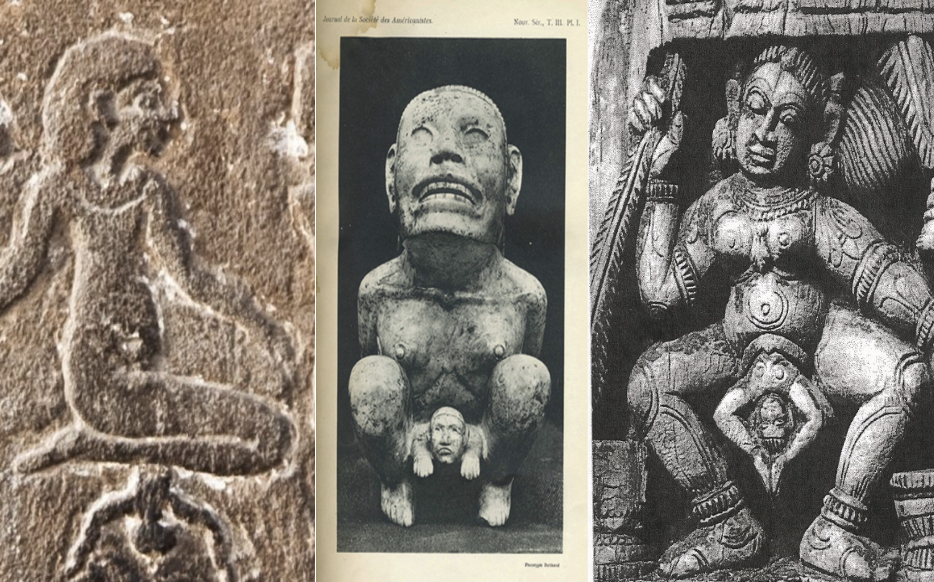
These representations of upright birthing positions can be found across cultures and centuries, suggesting that this may have been the predominant method of childbirth throughout human history (which makes sense, given its physiological advantages). Stone sculptures of the Aztec goddess of childbirth (12th century), Tlazolteotl, and depictions of Kali as a generative force in Hindu cosmology (18th century wood carving above) are among many examples that position birth as an active, powerful act.
There is agency and vitality in these images, which is why they bring up the wild woman archetype for me. Here, birth appears less as an extraction than as a passage. It’s a movement between worlds actively facilitated by the birth giver.
This does not mean that historical birth cultures were inherently freer, safer or more empowering than contemporary ones. Nor do such images reveal some universal feminine essence. But they suggest that birth has long been observed and imagined as powerful, transformative and resistant to control.
Looking at how many women are drawn to freebirth narratives, and to ideas of wild, sovereign births beyond medical structures and in close relationship with the natural world, I feel that the appeal is incredibly old.
At the same time, I am increasingly cautious about how this figure circulates in contemporary visual birth culture — especially in birth vlogs, social media and some freebirth narratives. YouTube and Instagram are saturated with birth imagery: sometimes bloody and loud, sometimes quiet and bathed in soft pastel tones, often shaped through recognisable visual languages of authenticity and empowerment. Even when not explicitly prescriptive, these representations can produce ideals of what a meaningful, powerful or “good” birth should look and feel like.
The wild woman is so compelling that she can easily become a marketable and potentially dangerous object of visual consumption: the woman who trusts only herself, rejects intervention, transcends fear and births in complete freedom. Agency becomes equated with sole responsibility, while structural failures of maternity care disappear behind narratives of personal empowerment. Ideas of a feminine essence can further marginalise trans* and queer realities, while cultural appropriation and spiritual language can obscure material realities.
Then the wild woman archetype — standing upright, mouth open, birthing in power — risks becoming an ideal through which lived birth experiences are measured, and from which some may awaken harshly when things go differently.
Nonetheless, most contemporary depictions of birth are still not images of powerful birth givers. So I completely understand the desire for alternatives. The wild woman archetype certainly works against the grain of medicalised birth culture.
Can we hold both worlds critically?
The wild woman archetype, in her many incarnations — including birthing upright — can be inspiring: we can visualise her before birth, meditate on her, pray to her. She can be a reminder rather than an ideal: a fierce reminder that birth will always exceed what can be measured, controlled or fully known.
